

Living in Bangkok as a student can be affordable with good financial planning. Based on my personal experience, a student can live on about 16,600–18,600 baht per month, covering accommodation, food, transportation and personal expenses.
Accommodation is usually the highest cost, ranging from 4,500 to 15,000 baht depending on whether you choose an apartment, condo or university dormitory. Food can be inexpensive if you eat at campus cafeterias or local street food stalls, while cooking at home can reduce costs further.
Transportation is also affordable with options like the 10-baht local bus, vans to the city and the BTS or MRT.
By budgeting carefully and choosing affordable options, students can manage living costs and enjoy studying in Bangkok
Introduction
If you are planning to study in Bangkok, one of the first things you should understand is the cost of living. Knowing the living costs before moving to a new country is very important. It helps students plan their budget, avoid financial stress and manage their daily life more comfortably.
When you already have a clear idea about how much money you might spend each month, it becomes easier to make better decisions about housing, food, transportation and other daily expenses.
However, the living cost in Bangkok is not the same for every student. It can be very different depending on several factors. For example, your lifestyle plays a big role. Some students prefer to eat at restaurants often, travel frequently or shop regularly. Others prefer cooking at home and spending less on entertainment.
Housing choices also affect the total cost. Living in a private condo near the city center is usually more expensive than sharing an apartment or staying in a dormitory.
In addition, everyone has different personal spending habits. Some people like to save money carefully, while others may spend more on comfort and convenience.
Because of these differences, the monthly cost for students in Bangkok can vary a lot.
In this guide, I share the living costs based on my own experience as a student in Bangkok. I try to manage my budget carefully and limit my spending to around 18,000 baht per month. This budget includes my basic living expenses such as accommodation, food, transportation and other daily needs.
Of course, this budget may not be the same for everyone but it can give you a general idea of how a student can live in Bangkok with a limited budget.
If you are planning to study in Bangkok or are simply curious about student life here, I hope this guide helps you understand what to expect and how to prepare your budget better.
Student Living Cost Guide
Understanding student living costs can feel complicated at first, especially if you are moving to Bangkok for the first time. To make things easier, this guide breaks down the most common student expenses into clear sections.
The major categories of student living costs include:
- Accommodation
- Food and daily meals
- Transportation
- Study materials and personal expenses
Each category plays an important role in shaping the overall monthly budget.
Some students focus on saving money by choosing cheaper accommodation and cooking at home. Others prefer comfort and convenience, which may increase their spending.
By understanding these different expenses, students can plan their finances more effectively before moving to Bangkok.
Accommodation
Accommodation is one of the most important things students need to consider when planning their living costs in Bangkok.
The place you live affects:
- your monthly budget
- your comfort
- your daily student life
Students spend a lot of time in their rooms for studying, resting, and sometimes completing assignments. Because of this, choosing the right accommodation is very important.
In Bangkok, room prices for students usually start at around 4,500 baht and can go up to about 15,000 baht per month. The price depends on several factors such as:
- location
- building type
- facilities
- room size
Some students prefer to stay in cheaper places to control their budget. Others choose places with more facilities for comfort and convenience.
Most students near Bangkok University choose between apartments and condos. These are the two most common housing options. Another option is the Bangkok University dormitory called DoBeDo. The main differences between apartments and condos include:
- room structure
- facilities
- electricity bills
In the following sections, I explain these options based on my experience and what I have learned as a student living in Bangkok.
 Image sourced from the Bangkok University official website for reference
DoBeDo (Bangkok University Student Residence)
Bangkok University provides a dormitory for students called DoBeDo. This dormitory is located inside the Bangkok University compound, near the end of the campus area. Because it is inside the university area, it is very convenient for students to travel to their classes.
The rooms in DoBeDo are designed specifically for students. The layout and furniture are simple but practical. Students can comfortably study, relax and manage their daily routines.
Another important point is the environment. The environment in DoBeDo is quite different from other condos or apartments near Bangkok University. Since most residents are students, the atmosphere is more suitable for studying and student life. Many students feel it is easier to focus on their studies when living in a place where others share a similar routine.
DoBeDo also offers good facilities that support student living. Because it is designed specifically for university students, the overall environment feels more student-friendly.
The price for staying at DoBeDo usually ranges from 12,000 to 15,000 baht per month. Although this price may be higher than some apartments and condos, the convenience of living inside the university compound and the student-focused environment are important advantages.
Apartment
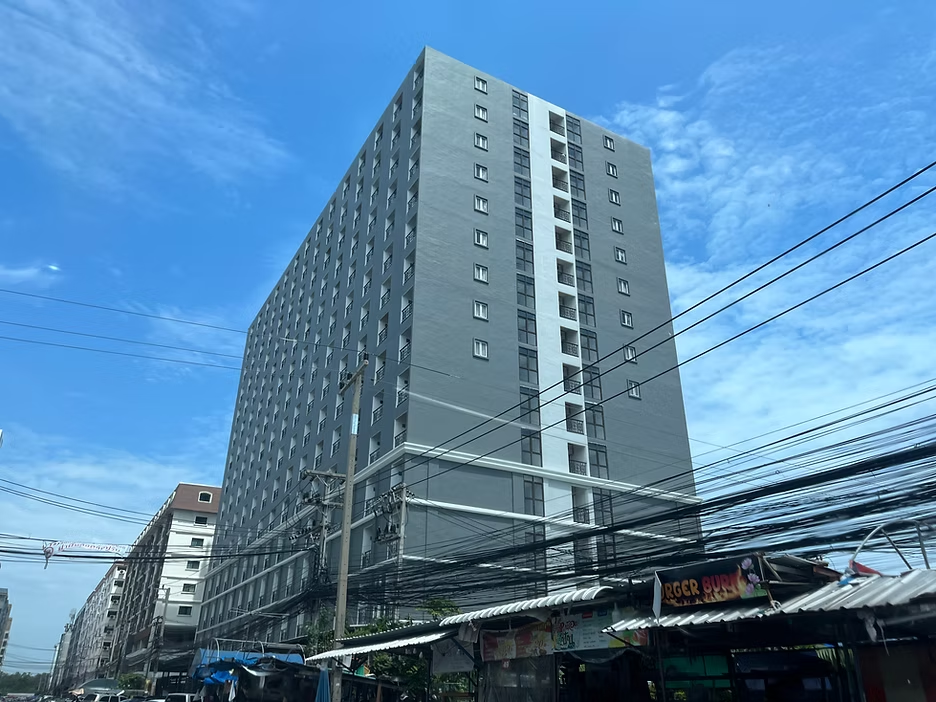 Image sourced from the SkyView Apartment official website for reference
Apartments are one of the most common choices for students who want to save money on accommodation. Compared to condos, apartments are usually more affordable. One noticeable feature of apartments is that the rooms are generally larger than condo rooms.
The room layout in many apartments looks similar to a hotel-style room, with basic furniture such as:
- bed
- wardrobe
- small table
Even though the rooms are larger, the design is usually simpler compared to condos.
Apartments often focus more on practical living rather than modern design. Another important thing to consider is the electricity bill. In many apartments, the electricity cost is about 7 baht per unit. If you use air conditioning often, the electricity cost can become a noticeable part of your monthly expenses.
Some apartments also provide basic facilities for residents. For example:
- gym room
- swimming pool
However, the facilities may not be as large or modern as those in condos.
The price for apartments near Bangkok University usually ranges from about 4,500 to 7,000 baht per month. Because of this lower price range, apartments are often chosen by students who want to manage their budget carefully.
Condo
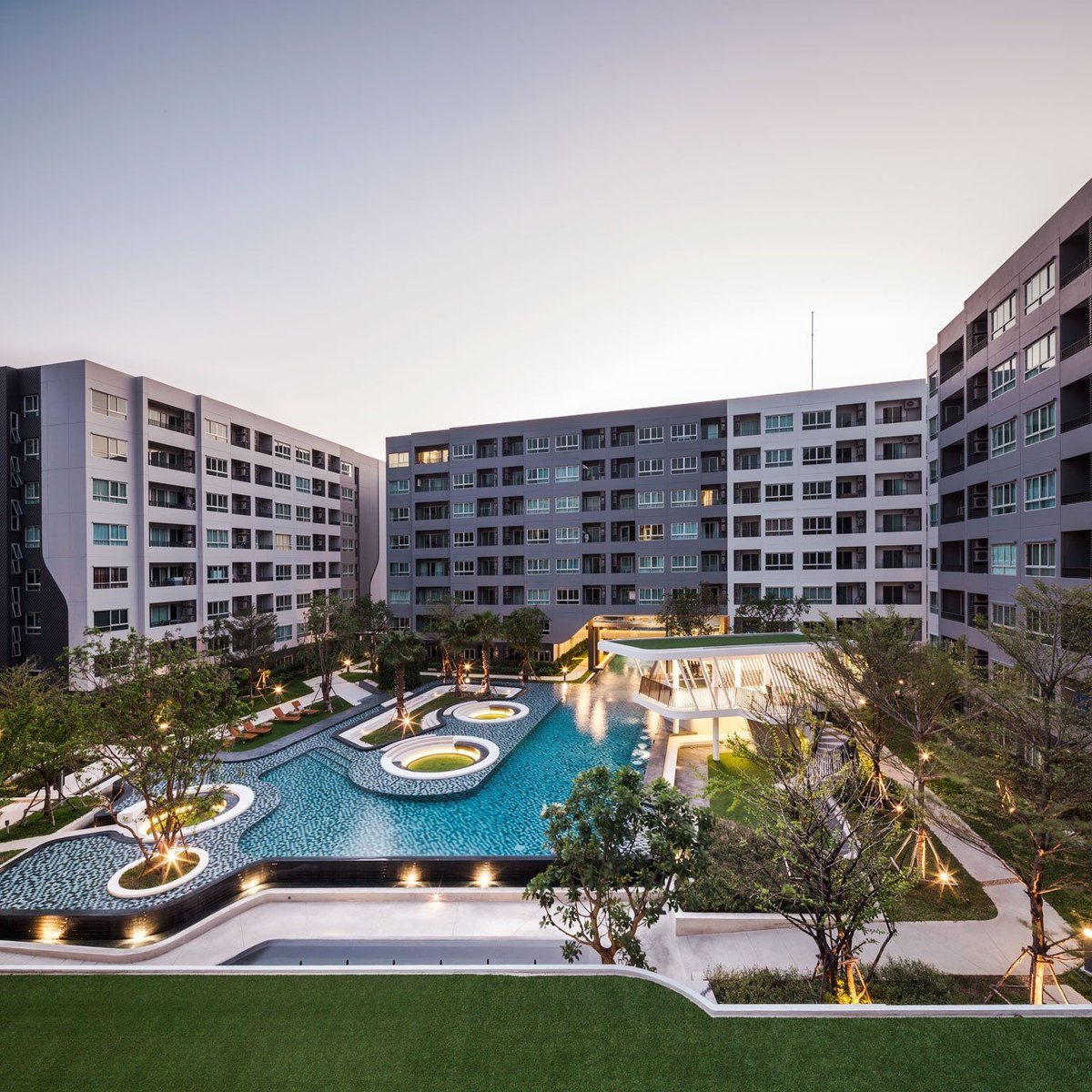 Image sourced from Kave Town Island official website for reference
Condos are another popular accommodation choice for students in Bangkok. Compared to apartments, condos usually offer more modern rooms and better facilities. The price for condos usually starts at around 7,500 baht and can go up to about 15,000 baht per month.
One major difference between condos and apartments is the room structure. Condo rooms are usually smaller but more organized. The layout is often more structured and modern.
Most condo rooms already include several basic appliances such as:
- refrigerator
- microwave oven
- television
These appliances are helpful for students because they make daily life easier. For example, students can store food in the refrigerator or heat meals quickly using the microwave.
Condos are also known for their variety of facilities. Many condo buildings provide shared spaces for residents such as:
- gym
- swimming pool
- movie room
- KTV room
- co-working space
- meeting room
- lobby
- common areas for relaxing or studying
These facilities can improve students’ living experience because they provide spaces for studying, exercising and socializing.
Another important advantage of condos is the electricity bill. In many condos, electricity costs about 4 baht per unit which is lower than in many apartments. Because of the facilities and lower electricity rate, many students choose condos even though the rent is usually higher than apartments.
| Type |
|
|
|
Electricity Cost |
|
||||
|
12,000 – 15,000 |
Rooms designed specifically for students | Good facilities and student-friendly environment inside the university compound | Depends on dormitory system | Students who want convenience and campus life | ||||
|
4,500 – 7,000 | Larger rooms, usually similar to a hotel-style room | Some apartments provide gym and swimming pool | Around 7 baht per unit | Students who want to save money | ||||
| Condo | 7,500 – 15,000 | Smaller but well-structured and modern rooms | Gym, swimming pool, movie room, KTV room, co-working space, meeting room, lobby, and common areas | Around 4 baht per unit | Students who want more facilities and comfort |
Shared Accommodation with a Roommate
Another way students reduce their living costs in Bangkok is by sharing accommodation with a roommate. This option allows students to divide the rent and sometimes other living expenses. For example, if the rent for a room is 10,000 baht, two people sharing the room may only need to pay 5,000 baht each. This can significantly reduce accommodation costs. However, sharing a room also requires careful consideration. If two people just met and decide to share a room, there may be many things to watch out for.
Different people have different:
- habits
- daily routines
- personalities
If you already know your roommate well, such as a close friend or trusted classmate, sharing accommodation can be easier.
You may already understand each other’s lifestyle and preferences. Having a good roommate can reduce your living costs and make daily life more enjoyable. However, a bad roommate experience can create stress and may affect relationships.
Living together requires:
- communication
- respect
- understanding
One important thing to remember is that not every roommate will become your friend. At the same time, sometimes a good friend can become a very good roommate. Because of this, choosing the right roommate is just as important as choosing the right place to live.
| Option | Cost Benefit | Important Note | |
| Sharing a room with a roommate |
|
It is better to share with someone you already know because different habits can cause problems |
Food and Daily Meals
Food is one of the daily expenses that students need to consider when living in Bangkok. Students usually spend money on breakfast, lunch, snack time, dinner and drinks throughout the day.
One interesting thing about Thailand is the wide variety of drinks available everywhere. Students can easily find different types of soft drinks, milk tea, fruit tea, iced coffee and other beverages in convenience stores, cafés and small drink shops. Because there are so many choices, it can be tempting to buy drinks often. However, these small purchases can slowly increase monthly expenses.
The cost of food in Bangkok can vary depending on where students choose to eat. Some places offer very affordable meals, while others can be more expensive. To understand food expenses better, it is helpful to look at the most common options students usually choose.
Cafeteria at Campus
One of the most convenient and affordable places for students to eat is the campus cafeteria. University cafeterias are designed to provide meals for students at reasonable prices. Students can usually find different types of Thai food, rice dishes, noodle dishes and snacks. The average price of meals in the campus cafeteria usually ranges from 45 to 80 baht per meal. For drinks, students can find options such as bottled water, tea, milk tea, coffee, and soft drinks. Drink prices usually range from 15 to 110 baht, depending on the type of drink. Because the cafeteria is located inside the campus, it is also very convenient for students who have limited time between classes.
Many students choose to eat at the cafeteria regularly because it is both affordable and accessible.
7 Eleven
Convenience stores such as 7-Eleven are extremely common in Thailand. Students can find a 7-Eleven almost everywhere, including near universities and residential areas. At 7-Eleven, students can buy ready-to-eat meals such as rice dishes, sandwiches, noodles and snacks. These meals are easy to heat using the microwave inside the store. The average cost for a meal and drink from 7-Eleven usually ranges from 80 to 120 baht. At first, many students may think that eating at 7-Eleven is a cheap option. However, if students eat there very often, the cost can become higher than expected.
Compared to local food stalls or campus cafeterias, 7-Eleven meals are sometimes more expensive. Because of this, relying on convenience store meals every day may increase monthly food expenses.
Local Food
Local food is one of the best options for students who want to eat affordable and filling meals. Thailand is well known for its street food and small local restaurants. These places usually offer a wide variety of dishes such as fried rice, noodle soup, stir-fried dishes and rice with different toppings. Most local meals cost around 45 to 75 baht, which is very affordable compared to many other cities.
Local food stalls are also very convenient because they can be found almost everywhere. Many students enjoy eating local food because it is both delicious and budget-friendly.
Café and Restaurants
Sometimes students may want to eat at cafés or restaurants. These places usually offer a wider variety of dishes including international food. However, meals at cafés and restaurants are usually more expensive compared to local food stalls. The price range for meals in cafés or restaurants usually starts around 80 baht and can go up to about 300 baht, depending on the menu and location.
Some international students also enjoy eating food from their home country. For example, if a Burmese student wants to eat Burmese food at a Burmese restaurant near the university area, the price usually starts from around 80 baht per meal.
Eating at cafés or restaurants occasionally can be a nice experience but doing it frequently can increase monthly food expenses.
Cooking at Home
Cooking at home is often the most affordable food option for students. Students can buy groceries from local supermarkets or markets and prepare their own meals. The cost of groceries can vary depending on what students buy. However, for simple meals, the cost is usually manageable. For example, based on my own experience, I usually spend around 300 to 500 baht per week on groceries. Cooking also allows students to control their ingredients and portion sizes. However, not all students cook regularly. Some accommodations may not have full kitchen facilities or students may have busy schedules that make cooking difficult.
Even so, combining home cooking with other affordable food options can help reduce overall food expenses.
Managing Food Costs as a Student
Food spending can change depending on daily habits and lifestyle. Students who often buy drinks, snacks or café meals may spend more money compared to students who mainly eat simple meals or cook at home.
For students who are managing a monthly budget like mine, it is helpful to balance different food options. Eating at the cafeteria or local food stalls can keep costs low while occasional café visits or restaurant meals can still be enjoyed without exceeding the budget.
In the end, the key to managing food expenses is balance and awareness of daily spending. Small choices such as buying drinks frequently or eating at more expensive places can gradually increase monthly costs. By paying attention to these daily habits, students can enjoy the variety of food in Bangkok while still staying within their budget.
| Food Option | Average Price (Baht) | What You Can Get | Notes |
| Campus Cafeteria | 45 - 80 | Rice meals, noodles, fried rice, simple Thai dishes | Affordable and convenient for students |
| 7 Eleven | 80 - 120 | Ready meals, sandwiches, instant noodles, drinks | Quick and convenient but daily spending can add up |
| Local Food | 45 - 75 | Thai street food, rice meals, noodle dishes | Freshly cooked and usually affordable |
| Café & Restaurants | 80 - 300 | Western food, specialty meals, café dishes | Comfortable place to eat or study |
| Cooking at Home | Around 300 - 500 per week | Groceries such as rice, eggs, vegetables, chicken | Most affordable option if you cook regularly |
Transportation
Transportation is another important expense students should consider when living in Bangkok. Fortunately, Bangkok offers several transportation options that can fit different budgets.
Students can choose cheaper options for daily travel or use faster transportation when traveling longer distances.
10 Baht Talaad Thai Bus
One of the cheapest transportation options for students is the 10 baht local bus. These buses usually operate around local areas and can help students travel short distances at a very low cost. Because the price is only around 10 baht, many students use these buses for simple daily travel near their accommodation or university area.
Motorcycle Taxi
Another common transportation option in Thailand is the motorcycle taxi, which many locals simply call a bike taxi. Motorcycle taxis are useful for short distances or when students need to travel quickly. They are often found near convenience stores, residential areas or university entrances.
Although motorcycle taxis are faster, they are usually more expensive than buses. The price depends on the distance traveled.
Van to Victory Monument
For students at Bangkok University International, there are vans located on the opposite side of Bangkok University that travel to Victory Monument which is a central transportation hub in Bangkok. These vans are commonly used by students who want to travel from the university area to the central city.
Because they provide a direct route, they are convenient for students who want to explore other parts of Bangkok.
Public Bus
Bangkok also has a large public bus system that connects many parts of the city. Public buses are another affordable option for students who need to travel longer distances. The bus routes cover many areas including shopping districts, residential neighborhoods and transportation stations. Students who are familiar with the bus routes can travel around the city at a reasonable cost.
However, for new students or international students, using the public bus system may take some time to understand because there are many routes and stops. Once students become familiar with the routes, buses can become a convenient way to travel.
Public Transportation (Bus, BTS, MRT)
Bangkok also has several public transportation systems that students can use.
These include:
• Public buses
• BTS Skytrain
• MRT subway
The BTS and MRT are especially useful for traveling longer distances quickly.
Although they cost more than local buses, they are faster and more comfortable. Students often use these systems when traveling to shopping malls, tourist areas, or other districts in Bangkok.
Transportation Inside the Campus
Inside Bangkok University, students also have some transportation options. One helpful service is the campus shuttle bus, which students can use for free. The shuttle bus helps students move around the university area, especially when traveling between buildings.
Some students also choose to rent scooters for personal transportation. Renting a scooter can provide more flexibility but students should also consider safety and traffic conditions.
Transportation Cost Overview
| Transportation Type | Estimated Cost | Notes |
| 10 Baht Local Bus | 10 | One of the cheapest options |
| Motorcycle Taxi | Depends on distance | Faster but more expensive |
| Van to Victory Monument | 45 | Direct travel to central Bangkok (Victory Monument) |
| Public Bus | 18 - 20 | Widely available |
| BTS / MRT | Moderate cost | Fast transportation for longer distances |
| Campus Shuttle Bus | Free | Only inside Bangkok University |
| Scooter Rental | Depends on rental | Personal transportation option |
Managing Transportation Costs
Transportation costs for students in Bangkok can vary depending on how often they travel and which transportation methods they use. Students who mainly stay around the university area may spend very little on transportation, especially if they use the 10 baht local bus or the free campus shuttle bus. On the other hand, students who travel to the city frequently using BTS, MRT or vans may spend more on transportation each month.
For students managing a limited monthly budget, it is helpful to combine different transportation options. For example, using cheaper options like local buses for daily travel and using BTS or MRT only when necessary.
Overall, Bangkok offers many transportation choices for students. With careful planning and smart choices, students can travel around the city while still keeping their transportation costs within their monthly budget.
Study Materials and Personal Expenses
Besides accommodation, food and transportation, students also have several additional expenses that are part of everyday life. These include study materials, communication costs, personal shopping and entertainment. Although these expenses may not seem large individually, they can add up over time.
Books and Study Materials
Students may need to buy textbooks, notebooks, stationery or printing services. Some courses require specific textbooks while others provide digital materials. Students can sometimes save money by buying second-hand books or sharing materials with classmates.
Mobile Phone Plans
Mobile phones are essential for students in Bangkok. Students use their phones for communication, internet access, online learning platforms and navigation. In Thailand, mobile phone plans are relatively affordable. Many students use prepaid or monthly packages that usually cost around 200 to 500 baht per month, depending on data usage.
Internet
Most accommodations already provide Wi-Fi internet, which is included in the monthly rent. However, if internet is not included, students may need to pay an additional monthly fee. Because many assignments and communications happen online, reliable internet access is very important for students.
Personal Shopping
Personal shopping is another category of expenses that students should expect. These expenses include daily personal items such as toiletries, skincare products and other basic necessities.
Students may need to buy items like shampoo, soap, toothpaste, laundry detergent or other personal care products regularly. These are normal daily items that everyone needs. Sometimes students also buy clothes, shoes or accessories. These purchases may not happen every month but they still affect the overall budget. The amount spent on personal shopping depends on individual habits and preferences. Some students only buy essential items and spend very little, while others may enjoy shopping more frequently.
On average, personal shopping and daily personal care items may cost around 500 to 1,500 baht per month for many students.
Entertainment and Social Activities
Student life is not only about studying. Students also need time to relax and enjoy their life outside the classroom. Social activities and entertainment are part of a healthy student lifestyle.
In Bangkok, students have many entertainment options. They can visit shopping malls, watch movies, explore markets, go to cafés or spend time with friends. Bangkok also has many parks and cultural places that students can visit.
The cost of entertainment depends on the activities students choose. Some activities such as visiting parks or walking around markets are free or very inexpensive. Other activities such as watching movies, eating at cafés or visiting entertainment places may cost more.
Many students set a small monthly budget for social activities so they can enjoy their free time without overspending. On average, entertainment and social activities may cost around 500 to 2,000 baht per month depending on lifestyle.
Managing These Expenses
Managing personal and study related expenses is an important skill for students. Even though these costs may seem small compared to accommodation or food, they still affect the total monthly budget.
Students who track their spending and plan their budget carefully can manage their finances more easily. Simple habits such as borrowing books from the library, choosing affordable mobile plans and limiting unnecessary shopping can help reduce expenses.
Overall, books, mobile phone plans, internet, personal shopping and entertainment are normal parts of student life in Bangkok. By understanding these expenses and planning ahead, students can enjoy their study experience while staying within their budget.
Estimated Monthly Budget Example
After discussing the main living costs such as accommodation, food, transportation and personal expenses, it is helpful to look at a simple example of a monthly student budget. Seeing the estimated numbers together can help students understand the overall cost of living in Bangkok and prepare their finances before moving here.
Of course, every student’s spending will be different. The total monthly cost depends on lifestyle, accommodation choice and personal habits. Some students may prefer more comfortable housing or spend more money on eating outside while others try to manage their budget more carefully.
In this section, I would like to share a simple monthly budget example based on my personal experience as a student living in Bangkok. I try to manage my expenses and keep my monthly spending within a reasonable range while still maintaining a comfortable student lifestyle.
Estimated Monthly Budget Table
| Category | Estimated Cost (Baht) |
| Accommodation | 9,000 |
| Electricity Bill | 1,000 |
| Water Bill | 200 |
| Food (Groceries) | 1,600 |
| Transportation | 800 |
| Personal Expenses | 4,000 - 6,000 |
| Total Estimated Budget | 16,600 - 18,600 |
Tips for Managing Student Expenses
Students can manage their expenses better by following several simple strategies.
Many places offer discounts for students. Always carry your student ID card.
Living near campus reduces transportation costs and saves time.
Local Thai food is affordable and widely available.
Tracking spending helps students control their finances and avoid unnecessary expenses.
Final Thoughts
Living in Bangkok as a student can be an exciting and rewarding experience. The city offers many opportunities for learning, cultural exchange and personal growth.
Although the cost of living may seem uncertain at first, it can become manageable with proper planning. Every student’s experience will be different because lifestyles and spending habits vary. However, by understanding common expenses such as accommodation, food, transportation and personal spending, students can prepare their finances more confidently.
Preparing financially before moving to Bangkok can reduce stress and help students focus on their studies and enjoy their university life. With the right planning and budgeting, students can have a comfortable and meaningful experience while studying in Bangkok.
FAQs